AI Agent Control Plane

A governed path for agent calls.
At the gateway.

A governed path for company-built agents to supported models, services, and other agents. Identity, deterministic policy, and metadata-safe activity are enforced at the gateway.

Get early access
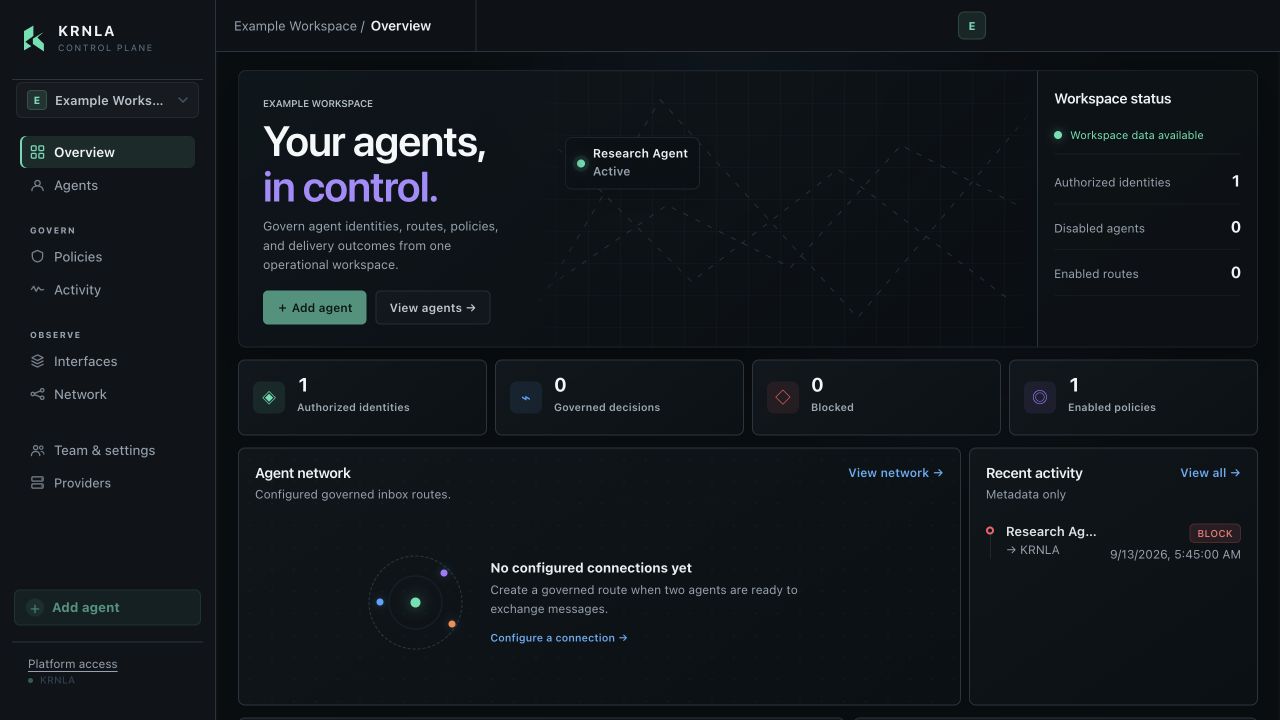
KRNLA dashboard showing agent identities, policy decisions, configured connections and metadata-only activity in an example workspace
Actual KRNLA dashboard · Synthetic demo workspace
THE PLATFORM

One control plane. A clear path.

From agent identity to governed delivery and recorded activity.

01 / Identity

Every agent has an identity.

Register once. Give each agent its own scoped KRNLA credential. Rotate, revoke or disable access from the control plane.

Provider credentials stay server-side.
Research agentScoped KRNLA identity
Agent credentialAgent-scoped
Provider credentialServer-side
02 / Policy

Policy lives at the Gateway.

Define rules in the dashboard. The Gateway applies deterministic decisions to supported calls before transport.

Simulate bounded facts before enabling a change.
Agent + destination + request factsDeterministic policy
ALLOWBLOCKREDACT
03 / Inbox

Connect agents without public endpoints.

Configure an inbox connection. Governed content is queued for the destination agent to retrieve and acknowledge with its own credential.

Policy ALLOW and delivery acknowledgement are distinct.
Agent AAgent B
SendQUEUED
Retrieve + completeACKNOWLEDGED
04 / Activity

See decisions. Keep content private.

Review bounded decision and delivery metadata. Observed relationships come from acknowledged governed agent messages.

Activity storage excludes request and response bodies.
Illustrative activity
Policy decisionALLOW
Message outcomeACKNOWLEDGED
Observed relationshipAgent A → Agent B

One governed path for supported agent operations.

The Python and TypeScript SDKs send supported LLM and agent-to-agent operations through the Gateway. Policies apply there without policy code inside each agent.

Governance

Policy without application code.

Define conditions in the control plane. Attach actions. No policy logic lives inside your agents because it does not need to. The gateway enforces consistently, regardless of which agent makes the call.

Evaluate the current policy set against bounded facts before enabling a change.

  • Structured conditions on agent, destination, request, and context
  • Allow, block, and redact actions
  • Simulation mode before enforcement
  • Immutable published policy snapshots
  • No per-agent policy code

Review governed activity metadata.

The gateway asynchronously emits bounded metadata describing decisions, matched policy, outcomes, and time. Request and response bodies are not stored in activity records. Guaranteed audit delivery remains future work.

agent_id
target_id
decision
policy_id
timestamp
duration_ms
transport_outcome
trace_id
Activity Timelineillustrative records
Outbound request

openai.responses.create via retrieval-agent

ALLOW
Agent message

research.completed — blocked by current policy

BLOCK
Provider response

openai.responses.create — response contains PII

REDACT
Agent message

handoff.ready — acknowledged by registered agent

ALLOW

See how your agents actually interact.

KRNLA records observed relationships from governed agent activity. Historical evidence, not configured routing.

OrchestratorSub-AgentTool ExecRetrievalAgent EAgent FKRNLAgatewayLLM APIsToolsetVectorsCRMWarehouseExternal

Security by design.

Infrastructure that keeps security properties without requiring policy authors to reason about them manually.

Metadata-only activity

Activity records contain metadata and decisions only. Inbox message payloads are stored encrypted with a 24-hour TTL and cleared earlier on acknowledgement or terminal state where implemented.

Authenticated inbox delivery

Agent messages enter a policy-governed KRNLA inbox. Destination agents retrieve them with their own scoped credentials and acknowledge completion.

Scoped credentials

Agent credentials identify one agent. Provider credentials remain server-side and are never returned to agents.

Bounded activity records

Asynchronous activity stores metadata and policy decisions under explicit retention limits. Guaranteed audit durability remains future work.

RBAC on the control plane

Dashboard access is gated by organisation, role, and resource. No cross-tenant data exposure.

Policy simulation

Evaluate the current policy set against bounded facts before enforcement. The current simulator does not replay historical traffic.

Developer experience

Connect to KRNLA.
Use the governed methods.

Install the Python or TypeScript SDK, add one bootstrap call, and route supported agent messages or LLM requests through its governed methods.

01
Provision an agent identity

Register your agent in the KRNLA dashboard and receive a gateway credential.

02
Connect the SDK

Set the Gateway origin and one-time KRNLA agent credential in your server-side environment.

03
Write policy in the dashboard

Create rules against the agent, destination, and request. No code to deploy.

04
Review recorded activity

Governed paths emit bounded metadata about policy decisions and delivery outcomes.

Deploy governed
agent infrastructure.

KRNLA is accepting public beta access requests. Verify your identity, then wait for approval before entering the production console.

Production service · beta admission